
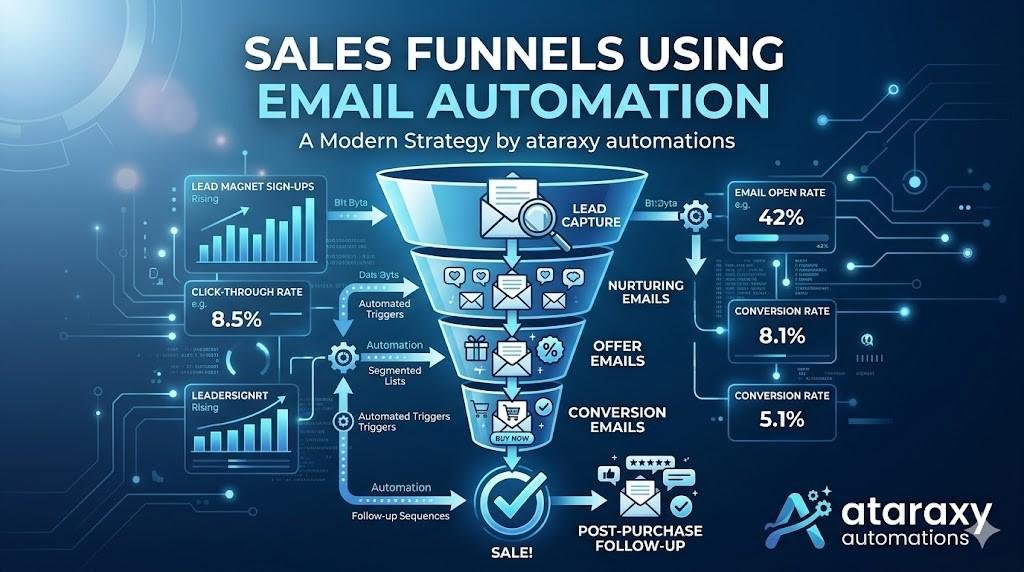
Sales Funnels Using Email Automation
Sales funnels are the backbone of successful lead generation and conversion strategies. But even the best-designed funnel can fall flat without a proper follow-up system. That’s where email automation comes in. By integrating email automation into your sales funnel, you can consistently engage leads, provide value, and move them through your funnel toward conversion without manual effort.
In this blog, we’ll walk you through how to build an effective sales funnel using email automation, helping you save time, increase conversions, and boost your revenue. Whether you’re just getting started or looking to optimize your existing funnel, this guide will give you the tools you need.
If you need help implementing a sales funnel that works for your business, feel free to call us at +1 (662) 400-6587, email us at AtaraxyAutomations@gmail.com, or visit our main shop page.
Why Sales Funnels + Email Automation?
Building a sales funnel using email automation is one of the most effective strategies for increasing conversions. Email allows you to build relationships with your leads, guide them through your funnel, and keep them engaged until they’re ready to take the next step — whether that’s booking a consultation, requesting a quote, or making a purchase.
Here’s why combining email automation with your sales funnel is such a powerful strategy:
📈 Increase Conversions
Email automation ensures that no lead is left behind. By sending timely, personalized emails based on the lead’s behavior or stage in the funnel, you can increase the chances of conversion.
⏱️ Save Time
Manual follow-ups are time-consuming and prone to errors. Email automation allows you to set up campaigns that work in the background while you focus on other important tasks.
💡 Provide Consistent Value
With automation, you can nurture leads with relevant content, answers to their questions, and personalized offers — all without lifting a finger.
🚀 Scale Your Efforts
A properly automated funnel can handle hundreds or even thousands of leads without additional work from your team. This is key to scaling your business and growing your revenue.
Now that you understand why email automation is so valuable, let’s walk through how you can set up a sales funnel using email automation.
Step 1: Define Your Sales Funnel Stages
Before you start creating emails, you need to define the stages of your sales funnel. A typical sales funnel consists of these main stages:
🔹 Awareness
At the top of the funnel, your leads are just becoming aware of your brand or offer. They may have subscribed to your list, downloaded a free resource, or expressed interest in some way.
🔹 Interest
In this stage, your leads show interest by engaging with your emails, visiting specific pages, or interacting with your business. They are starting to consider your product or service.
🔹 Decision
At the decision stage, leads are considering whether or not to make a purchase. They may need additional information, a special offer, or reassurance before they take the plunge.
🔹 Action
The final stage is where the lead takes the desired action, whether that’s making a purchase, booking a consultation, or signing up for a service.
🔹 Post-Purchase (Optional)
This stage is for retaining customers, encouraging repeat purchases, or upselling them on other services or products.
Once you have these stages defined, it’s time to create automated emails that move leads through the funnel.
Step 2: Build Your Email Automation for Each Funnel Stage
For each stage of your funnel, you’ll want to design a sequence of emails that gently guide your leads toward taking action. Here’s how you can approach it:
✅ Awareness Stage – Welcome and Introduction
Your first email in the funnel should introduce your business and explain the value of your product or service. This is often your welcome email.
Key Emails:
- Welcome Email: Thank the lead for subscribing or showing interest and set expectations for future emails.
- Value-Oriented Email: Provide a helpful resource (like an eBook, guide, or blog post) to build trust and add value.
The goal at this stage is to build trust and get the lead interested in learning more about what you offer.
✅ Interest Stage – Educate and Engage
Once your leads know who you are, it’s time to engage them further by providing more value and addressing their pain points.
Key Emails:
- Educational Email: Offer content that addresses common challenges your leads are facing.
- Case Study or Testimonial Email: Show how your solution has helped other customers in similar situations.
- Product Demonstration Email: Provide a closer look at your product or service, including how it works and the benefits.
At this stage, you want to build rapport, establish your expertise, and show how your product can solve their problems.
✅ Decision Stage – Create Urgency and Offer Incentives
In the decision stage, you’ll want to push the lead closer to conversion by making it easy for them to take action.
Key Emails:
- Offer Email: Present a clear offer or solution that addresses the lead’s specific needs.
- Discount or Incentive Email: Offer a time-sensitive discount, bonus, or limited-time offer to encourage quick action.
- Testimonial/Success Story Email: Reinforce your credibility with social proof, showing real results that others have achieved.
This is the stage where leads need that final nudge to make a purchase or schedule a consultation.
✅ Action Stage – Close the Deal
Once the lead has reached the final stage, it’s time to convert them into a customer.
Key Emails:
- Thank You/Confirmation Email: After the lead makes a purchase, send a thank-you email that confirms their action and sets the tone for future communication.
- Upsell or Cross-Sell Email: Offer related products or services to increase the sale or provide additional value.
Once they convert, you want to make them feel valued and continue the relationship through post-purchase emails.
Step 3: Set Up Your Email Automation Workflow
Once you’ve created your email sequences, it’s time to set up your automation workflow. Most email marketing platforms like Mailchimp, ActiveCampaign, or ConvertKit allow you to easily set up automated workflows that send emails based on actions and timing.
✅ Set Triggers
Determine what actions trigger the emails. For example:
- When someone subscribes to your list
- When someone clicks a link in your email
- When someone visits a specific page on your website
- When someone abandons their cart
✅ Set Timing
Decide how often your emails should be sent. For example, you might want to send an email every few days or after a certain amount of time has passed since the previous interaction.
✅ Personalize the Experience
Most email platforms allow you to personalize emails by using the lead’s name, location, or actions they’ve taken on your website. Personalization helps increase engagement and conversion.
Step 4: Test and Optimize Your Funnel
Once your funnel is running, it’s important to continuously test and optimize. Email marketing is not a “set it and forget it” strategy — it’s an ongoing process of improvement.
✅ Track Performance Metrics
Monitor key metrics such as:
- Open Rates
- Click-Through Rates (CTR)
- Conversion Rates
- Unsubscribe Rates
- Revenue Per Email Sent
✅ A/B Testing
Test different subject lines, email content, and CTAs to see which versions perform better.
✅ Adjust Based on Feedback
Use data to refine your funnel. If a certain email has a low open rate or high bounce rate, try tweaking it to improve performance.
Why Automated Sales Funnels Increase Revenue
Using email automation in your sales funnel has several key benefits for revenue generation:
1. Efficiency
Automation saves you time by running in the background while you focus on other important tasks.
2. Better Follow-Up
No lead falls through the cracks, and every prospect is nurtured through the funnel until they convert.
3. Improved Engagement
Automated emails are timely, relevant, and personalized, leading to higher open rates and stronger engagement.
4. Consistent Conversions
The funnel works 24/7, converting leads into customers even when you’re not actively working.
5. Higher ROI
Automated sales funnels allow you to maximize the value of every lead, improving your return on investment.
If you want to build an automated sales funnel that works for your business, call us at +1 (662) 400-6587, email us at AtaraxyAutomations@gmail.com, or explore our shop page.
Final Thoughts
Building a sales funnel using email automation is one of the most effective strategies to convert leads, increase engagement, and drive consistent revenue. With the right system in place, you can automate your follow-up, deliver value to your leads, and guide them toward making a purchase — all while saving time.
If you’re ready to create a profitable sales funnel for your business, Ataraxy Automations is here to help. We specialize in building custom email automation systems that work in the background, helping your business thrive.
Start today by visiting our shop page, calling +1 (662) 400-6587, or emailing AtaraxyAutomations@gmail.com.